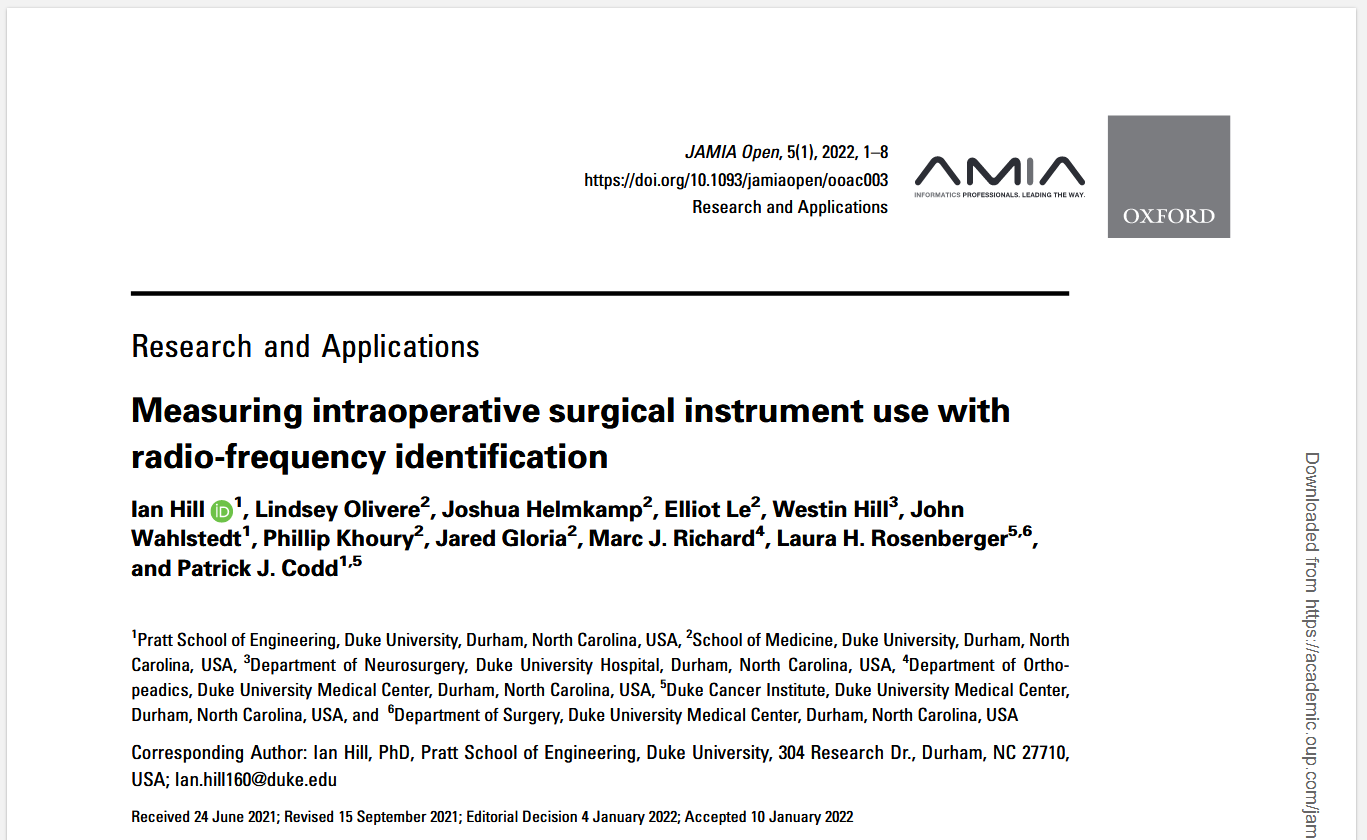
January 19, 2022 – Every hospital has preference cards. Almost none have reliable data on which individual instruments are actually used. That gap drives oversupply, adds work for perioperative teams, and makes tray optimization hard to scale. Our 2022 paper focuses on the measurement problem: can RFID accurately capture intraoperative instrument use in a way that’s practical in real operating rooms?
We developed an RFID system designed to capture instrument use automatically, without requiring scanning or line-of-sight. Instruments are tagged, antennas are positioned to observe the surgical site, and reads during the operative window are processed into a usable “used instrument” record. The system was evaluated across multiple procedure types to ensure it could generalize beyond a single workflow.
To quantify performance, we compared RFID-based use detection against trained human observation. We then calculated agreement across all logged “use” events. This matters because if measurement is noisy, supply changes become risky. If measurement is trustworthy, optimization becomes straightforward.
Across the monitored cases, RFID and human observation showed near-perfect agreement. The system achieved high sensitivity and strong specificity, capturing most instruments that were truly used while limiting false alarms. Just as importantly, the OR teams who interacted with the system did not find the tags or setup obtrusive, and there were no workflow safety issues reported during the study period.
Accurate measurement is only useful if it leads to change. Using RFID-derived use data, we identified substantial supply reduction opportunities in breast and orthopedic cases. Reduced trays were then used in subsequent cases with eliminated instruments held in reserve, and the teams did not need to pull back removed instruments. We also observed a faster setup time in breast cases after reduction and meaningful reductions in tray weight, which translates into less handling and less burden downstream.
Instrument variation shows up early. When we examined “new instrument appearance” by case number, the curve decayed quickly, suggesting you can learn a lot without tracking hundreds of cases before acting. That’s a key operational lever for hospitals: run a focused measurement window, make a defensible change, then keep validating.
A quote from Ian Hill, PhD, an author of the paper and Mente's CTO
Accuracy is the difference between a tray project that people trust and one that creates anxiety. When OR teams believe the data, we see them engage and actually support the optimization.
This paper is the backbone of what we productize at Mente: a reliable way to measure intraoperative instrument use and convert it into decisions that perioperative leaders can defend. When you can measure accurately, you can optimize confidently, communicate clearly, and sustain improvements without relying on constant manual audits.
Mente is a surgeon-founded company building a data-driven operating room. We capture instrument usage automatically, then use that evidence to help hospitals and sterile processing teams supply fewer instruments while preserving clinical functionality and surgeon satisfaction.


© 2025 mente Inc. All right reserved.