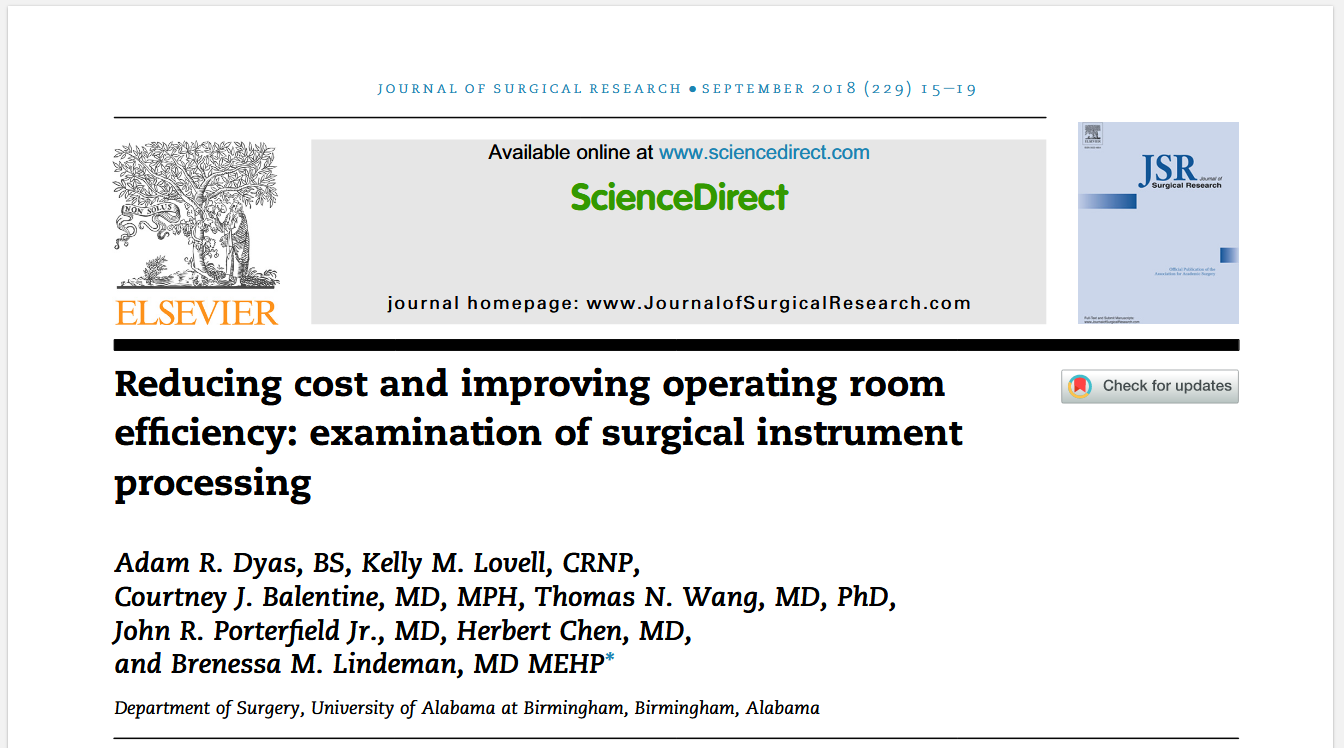
March 10, 2021 - Dyas et al. published a practical, numbers-forward paper on streamlining thyroid and parathyroid instrument trays. We spoke with Dr. Brenessa Lindeman (UAB) and separately with Dr. Courtney Balentine (UT Southwestern, co-author) about what the paper does not capture: multi-site complexity, naming chaos, preference card pain, “major tray” politics, and the slow creep that tries to undo every improvement.
This post is part of a short series with a consistent structure: what the paper shows, what the conversation adds, a practical playbook, and how Mente makes it faster and longer-lasting.
The paper starts from a familiar constraint: OR efficiency gets throttled by instrument processing delays, and standardized trays often carry instruments that are rarely used.
Their intervention was straightforward. Head and neck trays were evaluated by OR team leaders, instruments were classified as necessary or unnecessary based on use during thyroidectomies and parathyroidectomies, and they measured what changed.
The results were concrete:
The Lindeman conversation added details that matter if you want your optimization to work beyond a single tray in a single room.
The reduction effort did not begin as a “research project.” It came out of a broader initiative to reduce operative costs, and the endocrine surgery group got the right people around the table early, including strong administrative buy-in. Onboarding was a stress test.
Dr. Lindeman joined while the streamlined tray was already in motion. She sent the instruments she felt she needed, compared them to the reduced tray, and the group added back two items after agreeing they were reasonable. That detail is small but important: standardization has to be robust to new surgeons joining the service.
Peel packs were helpful for their effort. One surgeon wanted a Lahey clamp in the tray, but it was available via peel pack. That is the recurring theme across these studies: keep the tray lean, and make exceptions safe and predictable.
Multi-site practice made everything harder. Across five surgeons operating at four locations, instrument names differed by site, and even “the same clamp” could mean different lengths or versions. Much of the pain was not clinical. It was vocabulary, labeling, and ensuring everyone felt confident the tray contained the right variant. Preference cards were a separate headache. The operational reality is that preference cards drift, and manually updating them is a burden that can quietly undermine standardization.
Balentine’s call added another lens: implementation dynamics in a system that is sensitive to cross-service politics.
At the VA, he described a similar hernia tray reduction project that was not published. The team went to sterile processing, learned how instruments were labeled and where peel-pack pulls were happening, and reduced excess with OR staff at the table. Two details stood out:
First, tray politics are real. If a tray is labeled as “major,” changes trigger a larger blast radius and more resistance, sometimes because multiple service lines touch it. They found it was easier to start with smaller trays used by fewer groups, even if they were common procedures. The goal was to minimize unintended consequences and avoid provoking the “you changed our tray” backlash.
Second, removing redundancy can create a new kind of risk. In one case, an instrument was dropped and there was no redundancy in the tray, which created urgency as the team tried to find a replacement. That experience pushed them to think deliberately about which key instruments should be quickly available in peel packs.
Finally, he described a context trigger that administrators recognize: a supply logistics failure that prevented surgery for a week created a strong wave of urgency, and the tray optimization effort rode that wave. Their primary metric at the VA was turnover time, not surgical volume. That matters if you are targeting facilities where success is judged by throughput reliability rather than adding cases.
Across the series so far, you can see three distinct routes to tray standardization.
Koyle shows the power of observation-driven consensus and formal balancing measures, but it carries a scaling cost if humans must observe cases continuously.
Cerfolio shows what decisive surgeon leadership can do quickly, but it risks drift unless rechecks are routine and the system keeps visibility on creep.
Lindeman and Balentine expose the messy middle: even when the reduction decision is “obvious,” the hard part is operational alignment across locations, instrument naming systems, preference cards, service-line overlap, and maintaining lean trays when people and settings change.
These interviews reinforced a simple idea: the biggest scaling problems are measurement and coordination. Hospitals struggle to answer questions that determine whether standardization sticks:
Mente is built to turn those questions into routine operations. By capturing instrument usage automatically and making it visible across procedures, surgeons, and locations, teams can reduce the burden of manual observation, quantify exception patterns, and detect drift early. That supports faster expansion beyond the first tray and longer-lasting improvements that do not depend on one committee remembering to meet every six months.
Mente is a surgeon-founded company building a data-driven operating room. We capture instrument usage automatically, then use that evidence to help hospitals and sterile processing teams supply fewer instruments while preserving clinical functionality and surgeon satisfaction.


© 2025 mente Inc. All right reserved.