


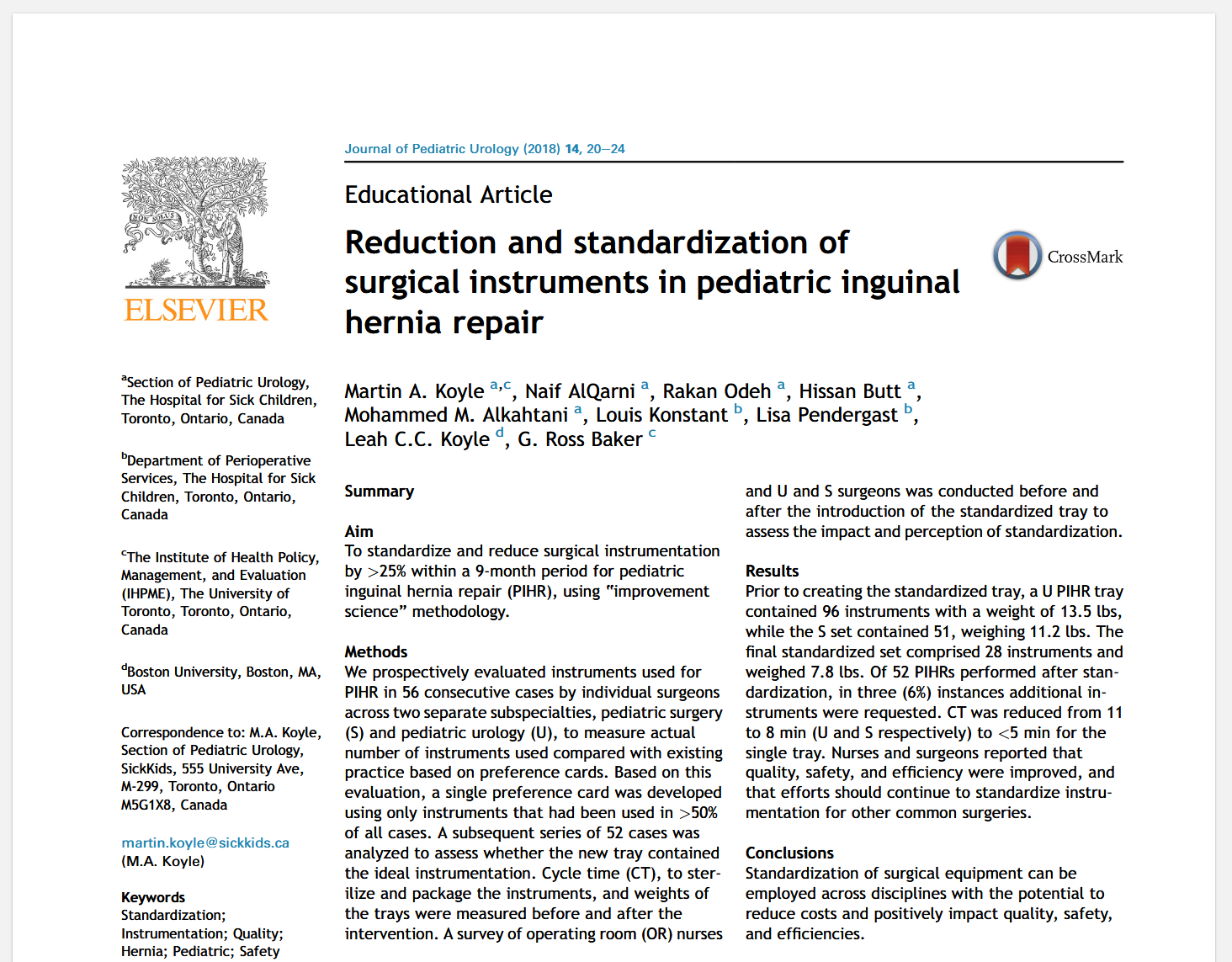
August 5, 2020 - Koyle et al. published a clear demonstration of tray reduction and standardization in pediatric inguinal hernia repair: fewer instruments, lighter trays, faster sterile processing, and minimal “we need the old set” moments. We spoke with Dr. Martin Koyle after reading the paper, and the conversation made the work feel less like a tidy quality improvement vignette and more like a playbook for scaling.
This post is the first in a short series where we use the same structure each time: what the paper shows, what the conversation adds, a practical playbook, and how Mente makes it faster and stickier.
The headline from Koyle et al.: standardization can work across surgeon groups, and you do not need to guess.
At The Hospital for Sick Children, the team targeted a common procedure performed by two subspecialty groups and compared what was on the preference cards vs what was actually used. Here’s what changed:
The method is also worth copying: trained observers counted instrument “use” from induction through closure, defining “used” as any instrument held at least once. The authors are candid about what remains hard: long-term sustainability was not measured.
The manuscript includes stakeholder engagement and governance at “paper altitude”: presentations, weekly meetings, and mechanisms for staff input. In our conversation, Dr. Koyle drilled into the gritty parts that determine whether a tray project spreads or stalls. Buy-in is a workflow, not a kickoff. The work requires repeated touch points, not just an initial announcement.
Exceptions are inevitable, but they do not have to become a veto. A small number of outlier needs can dominate the emotional tone of a project if you do not plan an exception path up front, like peel packs, defined add-ons, and clear escalation rules. Leadership sponsorship matters more than most teams admit. Momentum can fade quickly when champions move on and priorities shift. Measurement is the hidden scaling cost. The study’s observation method is rigorous, but staffing it and maintaining consistency becomes the bottleneck when you try to expand beyond a single tray. The study proves the upside. The interview reveals the constraint: measurement and governance that survive the next month,not just the next 52 cases
To repeat Koyle-style results, you want a repeatable approach for any service line, here’s our takeaway:
Koyle’s work shows tray optimization works when teams do the hard work: careful measurement, stakeholder engagement, and a safe exception pathway. Our conversation highlighted the two blockers to scaling that approach across dozens of trays.
Mente is built around those constraints. We capture instrument usage automatically and generate procedure and surgeon-level utilization evidence without requiring manual observers for every case. This approach delivers several benefits.
First: faster expansion beyond the first tray. You can start with one tray type and defined coverage, then scale to additional trays as you build confidence.
Second, we are able to deliver longer-lasting impact. Continuous usage data helps detect drift, quantify outlier needs, and revisit decisions when surgeon mix and leadership change, so standardization is not a one-time project binder that gathers dust. The manuscript includes stakeholder engagement and governance at “paper altitude”: presentations, weekly meetings, and mechanisms for staff input. In our conversation, Dr. Koyle drilled into the gritty parts that determine whether a tray project spreads or stalls. Buy-in is a workflow, not a kickoff. The work requires repeated touch points, not just an initial announcement.
Mente is a surgeon-founded company building a data-driven operating room. We capture instrument usage automatically, then use that evidence to help hospitals and sterile processing teams supply fewer instruments while preserving clinical functionality and surgeon satisfaction.



© 2025 mente Inc. All right reserved.

